
Saved by Grace, But Living by Performance: Why So Many Christians Are Still Striving for What Jesus Already Accomplished
Oct 13, 2026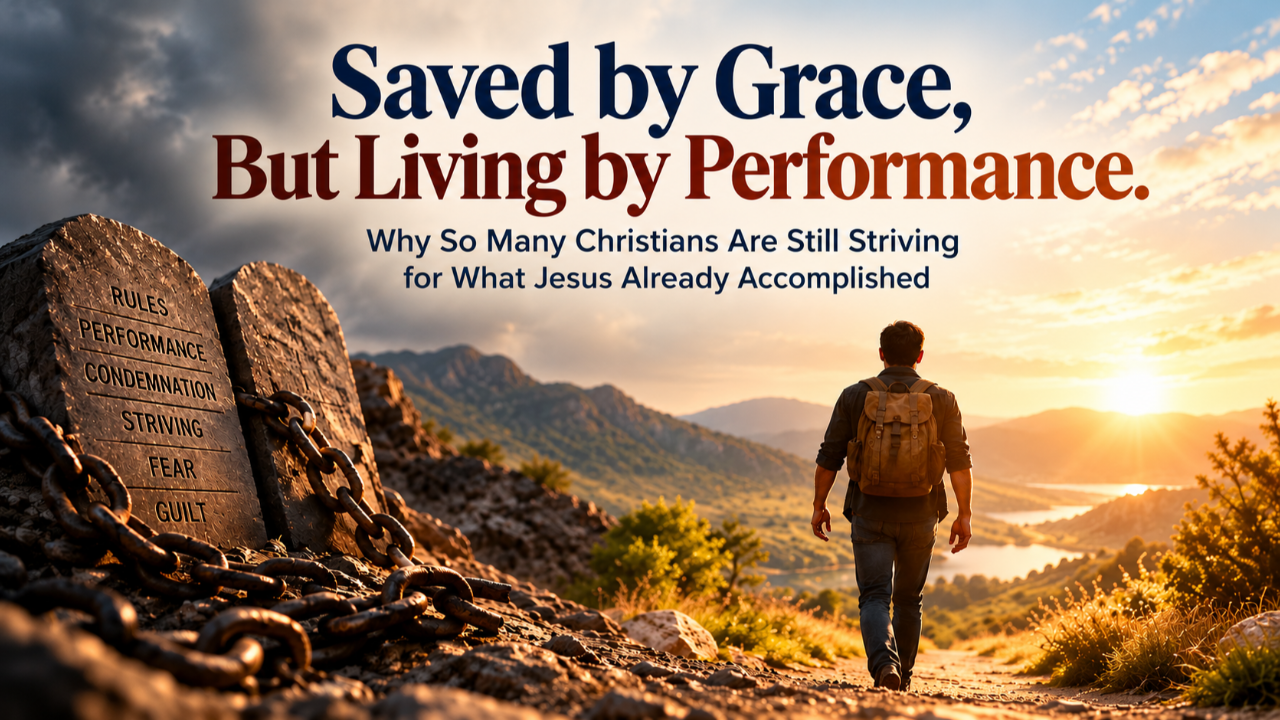
Have you ever wondered why our walk with God feels like a heavy burden sometimes? So many of us find ourselves stuck between two worlds. The Old Covenant, given through Moses, was built on conditions — blessing for obedience and consequences for failure, as we see in Deuteronomy 28. But the New Covenant, secured by Jesus, rests entirely on His finished work rather than our own struggle. Many of us trust Jesus for our eternity, yet we still walk our daily path in fear and striving. Understanding this shift opens the door to a peace that finally lets us rest.
Many of us have said the prayer and trusted Jesus for our salvation, yet we still wake up every morning feeling like we're on a performance review. We check our "scorecard" — how was our quiet time? Did we lose our temper? We measure His nearness by our own mood. If the day goes well, He feels close. If we stumble, He feels miles away and disappointed. It's like a car radio searching for a signal that keeps fading out — we are trying to tune in through our own effort. This is Old Covenant living, and I know how exhausting it is. I have spent many mornings staring at my Bible, feeling like a failure before the day even began.
The beautiful truth is that Jesus didn't come to help us follow the Old Covenant more perfectly. He came to fulfill it and invite us into something entirely new — a relationship based not on what we do for Him, but on what He has already done for us. I want to help us see this difference clearly, so we can stop living in fear and start walking in the freedom He purchased for us.
By the time we finish, I hope we'll all see what the Old Covenant required, what the New Covenant provides, and how to catch ourselves when we slip back into old patterns of striving.
What Is the Old Covenant?
Have we ever felt the weight of a standard we just couldn't meet? The Old Covenant was given at Mount Sinai, and it was a contract based on conditions. Think of it like a bank account: we only get out what we put in. No deposits of obedience meant no withdrawals of blessing. There was no middle ground — only the law and the outcomes of keeping it.
Deuteronomy 28 shows us these terms vividly. The chapter opens with a list of promises if the nation obeyed God fully:
"If you fully obey the Lord your God and carefully follow all his commands I give you today, the Lord your God will set you high above all the nations on earth... You will be blessed when you come in and blessed when you go out." (Deuteronomy 28:1–8)
That is an extraordinary promise. But the same chapter includes an equally sobering warning. Just a few verses later, the conditions flip:
"However, if you do not obey the Lord your God... all these curses will come on you and overtake you... The sky over your head will be bronze, the ground beneath you iron." (Deuteronomy 28:15–24)
When we read those side by side, we feel the heavy weight Israel was given. It's like a miner digging for silver in a mountain that keeps shifting — the work never ends, and the ground never feels solid. The entire covenant rested on human performance. And the problem — one we've all felt in our own lives — is that we simply cannot keep it perfectly.
The law itself was holy and good, but it was powerless to save us. It wasn't meant to secure our relationship through our work. Instead, the law was a mirror — it shows us the dirt on our faces, but it has no water to wash us clean. It reveals our need for something — for Someone — greater.
The law pointed. The law exposed. The law waited.
What Old Covenant Living Actually Looks Like
Do we ever find ourselves caught in the "If I... then God" trap? This isn't just an ancient history lesson. It is a pattern many of us still struggle with today. We can believe in the gospel and still live as though our closeness to God depends on our morning routine.
Here is what that sounds like in the quiet of our thoughts:
- "If I do good, God will bless me."
- "If I mess up, God is against me."
- "I need to fix myself before I can pray."
The core mindset is: If I do this… then God will respond. This path leads to a very predictable place. We feel the pressure. We carry the guilt. We feel a constant, low-grade sense of falling short. Even our time with Him becomes a checklist rather than a conversation.
Striving is empty. Fear is heavy. Guilt is loud.
What the Prophets Saw Coming
Have we ever longed for a change that went deeper than just trying harder? Long before Jesus arrived, the prophets were already pointing toward something the Old Covenant could never produce.
Jeremiah spoke of a day when God would lead us differently:
"The days are coming... when I will make a new covenant... I will put my law in their minds and write it on their hearts... For I will forgive their wickedness and will remember their sins no more." (Jeremiah 31:31–34)
Not rules on stone tablets, but life written on our hearts. Ezekiel carried this even further, promising that God would remove our "heart of stone" and give us a "heart of flesh." He promised to put His Spirit within us to move us toward His ways.
This is the shift that changes everything. Under the Old Covenant, we were told to do what we couldn't. In the New Covenant, God promises to do in us what He asks of us. He gives the heart. He puts the Spirit. He leads the way.
What Is the New Covenant?
What if we could stop building toward acceptance and start living from it? The New Covenant is a relationship based on receiving what Jesus has already done.
Jesus established it on the night before His death:
"This cup is the new covenant in my blood, which is poured out for you." (Luke 22:20)
When Jesus died on the cross for our sins, He put an end to the Old Covenant and established the New. The slate was not just wiped clean — the entire system changed. Paul tells us in Ephesians 1:3–13 that when we place our faith in Christ we are currently holy and blameless in His sight, forgiven, redeemed, adopted as His children, and sealed with the Holy Spirit. These are just some of the riches we have been given. Because He died for us, here are many of the benefits we now receive under the New Covenant:
- We are holy and blameless in His sight (Ephesians 1:4)
- We are forgiven and redeemed through His blood (Ephesians 1:7)
- We are adopted as His own children (Ephesians 1:5; Romans 8:15–17)
- We are sealed with the Holy Spirit as a guarantee of what is to come (Ephesians 1:13–14)
- We are a new creation (2 Corinthians 5:17)
- God is not counting our sins against us (2 Corinthians 5:19)
- We have been given His righteousness — He who knew no sin became sin for us, so that we might become the righteousness of God in Him (2 Corinthians 5:21; Romans 3:21–22; Philippians 3:9)
- Our righteousness is a gift received by faith (Philippians 3:9)
- We have bold, direct access to God (Hebrews 4:16)
- We are no longer under condemnation (Romans 8:1)
- And so much more — every spiritual blessing in the heavenly places is ours in Christ (Ephesians 1:3)
Not one of these is something we achieved. Every single one is something we received — and this is just a glimpse of the abundance that is ours in Christ.
The New Covenant is built on better promises and a better foundation. When we are living our life from the New Covenant these are the throughts that consistently run through our minds.
- "We are already loved and reconciled."
- "Our righteousness comes from Jesus, not our efforts."
- "God's faithfulness is our anchor, not our consistency."
The core mindset is: Jesus has done it. We receive it. This produces a rest the Old Covenant never could. We move from pressure to peace. Not because life becomes effortless, but because the foundation has shifted.
Jesus did it.
The Key Difference Between the Two Covenants
Where are we looking today — at our own record or at His? If we have placed our faith in Jesus, we are under the New Covenant. Yet so many of us still live like we are under the old. Old Covenant living focuses on what God might be counting against us. It keeps us trying to pay a debt that has already been cleared.
New Covenant living focuses on what God is counting toward us — the very righteousness of Christ. I encourage us to sit with this: we often try to reconcile ourselves to God, but the New Covenant says we are already reconciled. This is where so many of us get stuck — still trying to "get right" with a Father who has already brought us home.
Reconciliation isn't a mountain we climb. It's a gift we open.
The Role of the Holy Spirit
Are we tired of white-knuckling our way through faith? Old Covenant living relies on self-effort. "I need more patience" becomes a demand we place on ourselves.
New Covenant living relies on the Holy Spirit within us. I've tried to manufacture kindness on my own, and it usually lasts about five minutes. But when we walk in the Spirit, transformation becomes a prayer rather than a pressure: Holy Spirit, produce your fruit in me. It's the difference between carrying a heavy pack alone and letting a strong friend carry it with us.
He sees. He speaks. He leads.
Jesus as the Fulfillment of Both Covenants
To understand what Jesus did, let's look at what He stepped into. Adam, our first representative, disobeyed in a garden and brought us into shadow. Israel was called to be God's people, but their story was often marked by grumbling and failure.
Jesus is the Second Adam. The true Israel. What none of us could do, He did perfectly.
|
Theme |
First Adam |
Jesus, the Second Adam |
|---|---|---|
|
Representative role |
Head of the old humanity |
Head of a new humanity |
|
Response to God |
Disobeyed in a garden |
Obeyed the Father perfectly |
|
Result of his act |
Sin, condemnation, and death entered the world |
Righteousness, justification, and life come through Him |
|
Legacy |
A fallen family |
A new creation family |
|
Key passages |
Genesis 3; Romans 5:12–21 |
Romans 5:19; 1 Corinthians 15:45–49 |
Jesus followed the path where others stumbled. He passed through the waters and the wilderness, obeying completely where we could not. He bore the curse of the Old Covenant so we could receive the blessing of the New.
How to Recognize When We've Slipped Back
Have we noticed how Old Covenant thinking can feel like "being a good Christian"? It's subtle. Listen to your heart after we trip up. If our first thought is "I need to fix this before I can talk to God," that is the old pattern of performance.
Conviction is a gentle hand from the Holy Spirit drawing us toward God to heal. Shame is a cold wind driving us away. I encourage us to notice the difference. The next time we feel we must "do more" to be okay with Him — stop. Name it. Then try this simple shift: Jesus has done everything. We are living from His reality.
Let's bring our guilt and our tired hearts into His presence. Not to perform, but just to be. We don't need to earn our way back to Him today. We are already there.
A Final Summary: Old Covenant vs. New Covenant
|
Theme |
Old Covenant |
New Covenant |
|---|---|---|
|
Basis |
Our obedience to the law |
Jesus' obedience and resurrection |
|
Condition |
Obey to be blessed; fail and face the curse |
Grounded in Christ's finished work |
|
Mediator |
Moses |
Jesus, our better mediator |
|
Written |
On stone tablets |
On the heart by the Spirit |
|
Righteousness |
Earned (but never enough) |
Given through faith in Christ |
|
Access to God |
Limited and distant |
Bold and direct through Jesus |
|
Transformation |
Trying to change from the outside |
A new heart given from the inside |
|
Daily mindset |
"If I do this… then God will respond." |
"Jesus has done it. We receive it." |
Old Covenant says: "We need to do more for God."
New Covenant says: "Jesus has done everything. We now live in that love."
Frequently Asked Questions
Can we believe in Jesus and still live like we're under the Old Covenant?
Yes, many of us do. We can trust Him for our salvation while still trying to "earn" His daily smile. Recognizing this gap is the first step toward walking in grace. This is where God is encouraging us to stop striving and freely receive what Jesus has done for us.
Does New Covenant living mean we don't need to obey?
Not at all. It just changes why we obey. We don't obey to get God to love us — we obey because He already does. It flows from a thankful heart, not a fearful one. We are not loved because we are holy. We are holy because we are loved.
How do we know if we're relating to God through performance?
Look at our hearts when we trip up. If we feel we have to "fix it" before we can pray, we're leaning on performance. Let's bring the mess straight to Him instead.
What's the difference between conviction and shame?
Conviction is from the Holy Spirit and leads us toward God. Shame is from the enemy and tells us we don't belong with God.
Where can we go deeper with this?
At ComeClose Ministries®, we walk alongside people to guide them into personal encounters with God. If you are tired of striving and ready to start receiving, I invite you to see what we have available at comecloseministries.org — particularly our course called the Shame Detox™. https://www.comecloseministries.org/the-shame-detox-course
Grace and Peace to you!
Rick
